The Adventures of Huckleberry Pie
  • Home
  • The Cob Shop
    • The Little Cob That Could
    • A Lesson Well Learned
    • Little Cob That Saved Christmas
  • About the Author
  • Characters
  • Our Adventures
  • Cob Blog
  • Get Involved
Picture

The cob blog.

7 sins of the dressage ring

5/8/2018

1 Comment

 
Picture

​Dressage is the art of riding a set sequence of movements in a good rhythm and balance whilst make it look as effortless as possible. However there are some simple mistakes we as riders make which loose us marks in the arena. Here are seven of the common mistakes made in movements and how they can be solved. 
​

Picture
​

1. The Centre Line
​Its the first and last element of every single dressage test at all levels. Its the very first mark you get, so why would you not aim to make it a good one? So many riders hear the bell ring and make a mad dash for the entrance of the arena, this often leads to an unbalanced turn and more often than not the horse over or undershooting the centre line. Then we come to the issue of the actual line itself, its only a straight line, how hard can it be right? At the lower levels a straight line can be very difficult to perform for some combinations. 
​Top Tips to improve your score:
  • ​When the bell/whistle blows you have 45 seconds to enter the arena before you are eliminated so there is no immediate rush to get on the centre line. If you hurry you risk unbalancing your horse and getting a bad score. Instead keep a good rhythm and take your time to set your horse up properly before the turn.
  • Many riders only start to really ride their horses when they get into the arena, they often get too close to the boards and make a poor turn to enter which can lead to a wobbly centre line. Make use of the whole arena to your best advantage, by really using as much space around the outside the of the boards as possible. This should give you enough time to have your horse on a straight line before you get through the white boards.  

2. Riding Corners
​A dressage arena is rectangular, therefore is has four corners. In every single test we as riders have to ride into these corners several times throughout the test, I often see many riders getting so deep into the corner that they have to ride a right angle turn to get back out of it without exiting the arena or even worse riders cutting the corner completely.
​Top tips for getting it right:
  • ​Imagine a 10m circle in each corner and divide it into four, take away all the segments except those in the corners. this is the line you should be taking round each turn at every level.
  • Use half halts to help set up yourself and your horse before you arrive at the corner, riding the corners are just as important as the movements themselves and can be the making or breaking of a test.
​
3. Circles
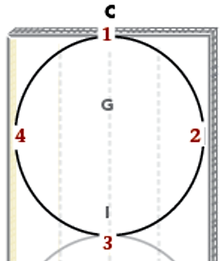
​All dressage tests contain circles and depending what level you are riding at, will depend on the size of the circle. At intro and Prelim 20m circles are expected, at novice 15m and from elementary onwards 10m circles in trot and canter. The biggest mistakes that riders make are the size and the shape. Often the circles are ridden either too small or too large and often resemble an egg shape or in some cases even a square. 
Tips to ride a good circle​
  • ​Imagine a 20m circle in one half of the arena and split it into four quarters starting from either A or C. Focus on riding each quarter, rather than the whole circle. You'll find it much easier to keep the size and shape correct by riding it this way.​
  • Think about the direction your horses head is pointing on the circle. If the head is turned to the outside it is much more difficult to control the rest of your horses body to be able to ride an accurate circle. By having inside bend (not to much though)  your horse will find it easier to keep his shoulders and hindquarters on the same track which will infinitely make for a better circle overall.​

Picture
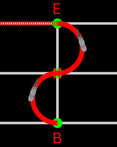
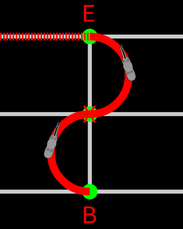
4.E half 10m circle to x half 10m circle to B
​The two half circles can be found at multiple levels from intro onwards. Common mistakes include cutting the circles too tightly and allowing them to fall in around the turn others make a good initial turn and then fail to right straight before turning onto the next half circle, resulting lower marks.
Top tips for a better mark:
  • ​Before you ride the first half circle make sure you rebalance your horse with a half halt and use your inside leg and outside rein to guide your horse around the first half circle.
  • After you have ridden your first half circle ensure you ride straight for two to three strides before riding the next half circle in the opposite direction. This allows you to rebalance your horse, change your inside aids and ride the next half circle correctly.  

5. Free walk on a long rein.
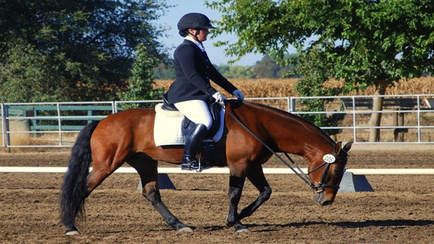
​I feel the reason people don't score as highly in this movement in a test, is because many riders don't actually understand the meaning behind the free walk. Ask any rider at the lower levels and they shall tell you that free rein is a case of letting your reins go loose and letting your horse stretch the neck. When in actual fact what the judge is looking for is for the contact to be lengthened and the horse to stretch over his back and neck as he follows the contact outwards and downwards, whilst maintaining a rhythmical walk.​
For better marks:
  • ​Ensure that the walk is forwards and active at all times. Use opposite legs in a left and right motion to encourage the walk as well as allowing your hips/waist to move in time with your horse so you don't restrict the activity
  • Before you allow the reins out be sure you are on the path you wish to take and then push your hands forwards a little as your horse reaches for the contact allow your reins out a little. Keep allowing the rein out until you horse stops reaching for the rein (hopefully as long and low as possible)

Picture
6 Give and retake the reins.
​This is a movement that has often been overlooked by both riders and judges for many years. On Attending a recent judges training evening It appears to be something that is now being highlighted as a major 'marking down' and sometimes even an error of course if this movement is not performed.  So it is very important that we must now be remembering to ride this movements as the potential loss of 2-4 marks could cost you a placing.
​Ride it correctly by :
  • ​Allowing your hands forwards towards the bit and let a small loop develop in your reins for approx. 2-3 seconds, your horse should maintain his balance and the frame he was in previously. 
  • Don't lift upwards as you take your hands forwards as this I incorrect and give the judge the impression you are holding your horse up, there has to be a slight slack in the reins.

​7. Changing the Rein.
​This movement is easy to ride isn't it? I mean its just riding from one marker to another right. But I see so many riders cutting the corner before the turn and missing the marker completely or getting to the marker and making a sharp turn which throws the horse off balance. 
​Top tips for better marks:
  • ​​Use the corner before the change of rein to set up your horse ready for the turn. Move the horse around the inside leg and half halt to rebalance.
  • Rather than turning as soon as your horses head reaches the marker, wait until your horses shoulders reach it before you make your move. Vice Versa for reaching the opposite track, aim for a little before the marker and aim to be on the track by the time your body comes in line with the marker. 

​I hope you have found this blog post useful and these tips really help you ride a more accurate test and gain a higher score.
Any questions please just ask and keep your eye out for future posts and videos on our social media pages (Facebook and Instagram) where we shall discuss and demonstrate everything we spoke about in this article.

​SS
1 Comment
Jackie flynn
5/15/2018 01:04:05 pm

Really learnt a lot from this.

Reply


Leave a Reply.

    FOLLOW OUR SOCIALS FOR DAY TO DAY ANTICS.

    Categories

    All
    Riding And Competition
    Stable Management

    RSS Feed

Services

Author & Writer
Freelance Qualified Riding Coach
Educational Workshop Provider & Speaker

Email: [email protected]
Tel: 07763805845
​
© COPYRIGHT 2019 - 2023. ALL RIGHTS RESERVED.
  • Home
  • The Cob Shop
    • The Little Cob That Could
    • A Lesson Well Learned
    • Little Cob That Saved Christmas
  • About the Author
  • Characters
  • Our Adventures
  • Cob Blog
  • Get Involved